
Lexington, SC · Tankless installs and repairs
Thinking about hot water that does not run out? Tankless water heater services in Lexington, SC
A tankless heater heats water as it flows instead of storing it, so it does not run out of hot water the way a tank can. It also asks more of the house: a bigger gas line, a different vent or a serious electrical circuit. The question is not whether tankless is better. It is if your house can support one. Below is what the tankless water heater services Lexington SC homeowners ask about involve, from gas and venting to the electrical load.
Call us and tell us what you have now and what you want. One of our plumbers can check the gas, the vent or the electrical load and tell you what the install involves.
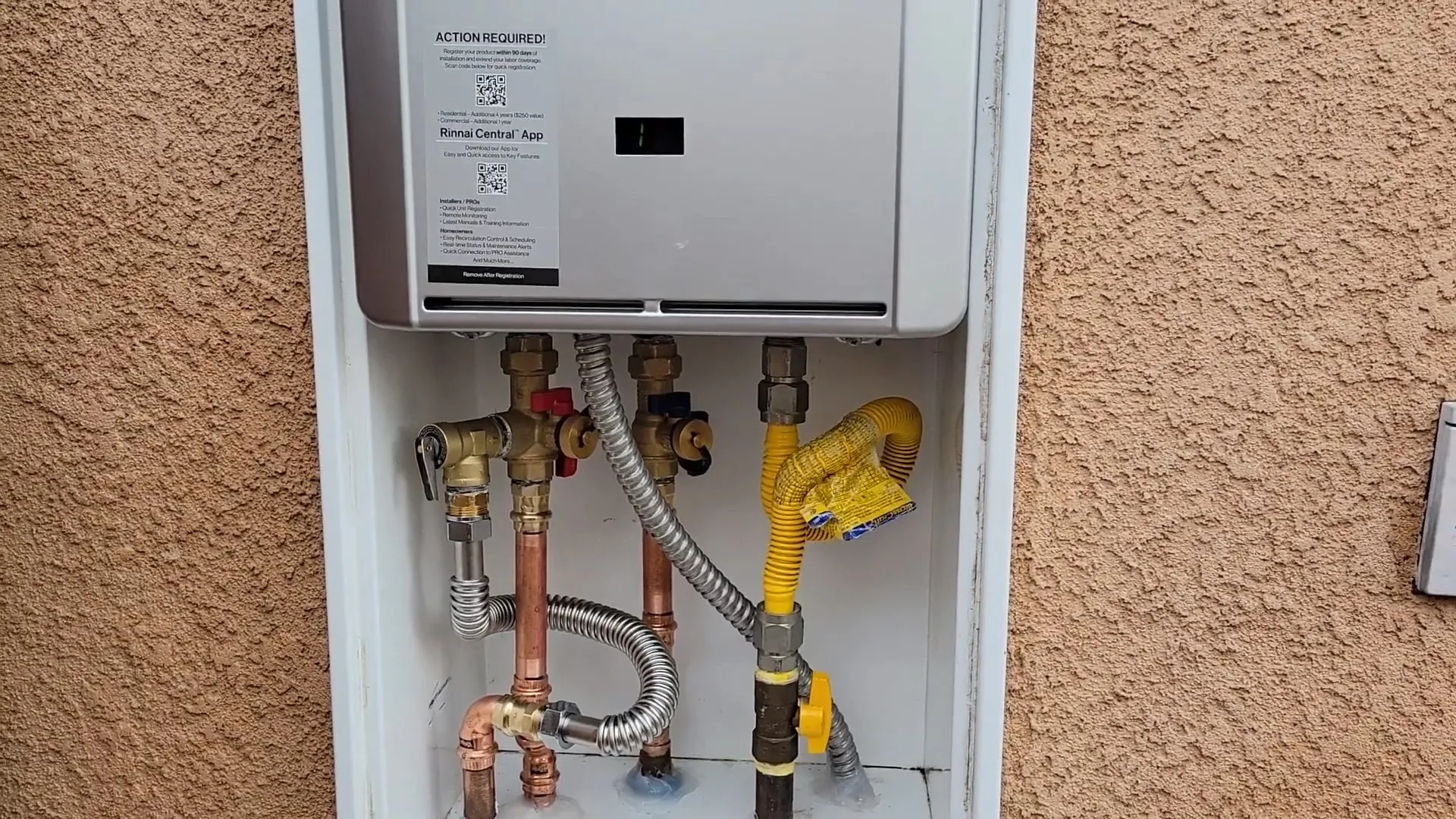
Is tankless right for this house?
| What to check | Why it matters | What to ask |
|---|---|---|
| Gas line size and meter capacity | A tankless gas unit draws a lot of gas at once | Ask the installer to size the line and the utility to confirm the meter can supply it. |
| Venting path | The exhaust must reach the outdoors by an approved route | Ask where the vent will run and what it will cost to change. |
| Electrical capacity for an electric unit | Whole-home electric units draw a large load | Ask for a load check of the panel and circuit. |
| How many fixtures run at the same time | Flow limits the number of simultaneous showers | Ask for the flow rating and a plan for peak use. |
| Space and access | Wall mounting and service clearance are needed | Ask where it will go and how it will be reached for service. |
If those answers are favorable, a tankless unit makes sense. If they are not, a good tank-style replacement may be the better decision. A plumber who explains both is more useful than one who only recommends one.
Think about how the house uses hot water. A household that runs two showers and a dishwasher at the same moment needs a unit rated for that load, and a bigger unit means a bigger gas line or a bigger circuit. A smaller household that showers one at a time may be well served by a smaller, simpler unit. Give the plumber real numbers for people, bathrooms and appliances.
Gas supply and venting: where installs get complicated
The usual surprise is the gas pipe. A tank heater sips gas. A tankless heater can draw several times as much when it fires. If the existing line is too small, it has to be upsized, which is covered under gas line upgrades.
Ask your gas utility if your meter can handle the added load. The installer should ask too, but a call from you can speed it. A smell of gas means leave the house and call the utility or 911 first.
Venting is the second surprise. Tankless units need a dedicated vent, often through a wall, and condensing models need a drain for the condensate they produce. Ask what the vent looks like on the outside of the house and where the condensate goes.
Scale and descaling: the maintenance you sign up for
Minerals in water build up as scale inside a tankless heat exchanger, which reduces flow and heat. Many manufacturers call for a periodic flush, so read the manual for your model.
- Ask the installer to fit service valves, which let the unit be flushed without cutting pipes.
- Ask the water utility that serves you for the hardness of your water, rather than assuming it, because we did not find a verified figure for Lexington.
- Ask how often the maker recommends flushing and who will do it.
- Keep a log of flushes. A warranty claim may ask for it.
Point-of-use and undersink units
A small electric unit under one sink makes hot water at that fixture only. It suits a far-away kitchen, a bar sink or a workshop that waits too long for hot water from the main heater.
It does not replace a whole-house heater. Flow is limited, it needs an outlet or a dedicated circuit and it serves a single fixture. Ask the installer what the unit's flow rating is and if the outlet is on a circuit that can carry it.
Before buying one, run the hot tap at the far sink and time how long the water takes to warm. If the wait is a minute or more and you use that sink often, a point-of-use unit is a modest fix. If only one fixture is slow, it usually costs less than re-piping or adding a recirculation line.
Repairing a tankless unit
Tankless heaters fail in model-specific ways. Many show a numeric error code on the display, and the code points to the cause: a vent problem, a flame sensor, a scaled heat exchanger or a water-flow fault.
- Write down the model number and the error code before calling.
- Check that the gas supply valve and the water valves are open.
- Do not open the cover. It exposes gas and electrical parts.
- Ask the plumber whether the repair is a part swap or a descaling flush, and if the unit is still worth repairing at its age.
Most tankless makers print the error codes in the manual, and a plumber can read them with the unit's service tool. Codes that clear after a reset and return within days point to a real fault rather than a one-time glitch. Tell the plumber when each code appears, because a code that shows only during a shower differs from one that shows at start-up.
A tank unit repairs differently, as covered in repairing a tank heater.
Freeze, permits and licensing
The National Weather Service puts the average last spring freeze for Columbia at March 16. A unit mounted outdoors, or a condensate line that runs outside, needs freeze protection before then. Ask the installer how the unit handles a freeze and what you must do.
Lexington County requires a permit to install or replace a plumbing, gas or mechanical system and exempts ordinary repairs. A tankless install involves all three. Ask who pulls the permit, and look up the license holder on the state license lookup before work begins.
For a sense of what changes a tankless quote, tankless cost factors lists the gas, vent and electrical items, and tankless questions answered covers what happens on a call.
Weighing a tankless upgrade?
Call us and describe your current heater and the house. One of our plumbers can check what the install needs.
Call (833) 571-0120